

Introduction
In today’s fast-paced corporate environment, decision overload is a common challenge among executives and managers. With hundreds of tasks, metrics, and updates fighting for attention, leaders often struggle to separate what truly needs their input from what can be handled at the team level. That’s where management by exception enters the equation. This concept isn’t about doing less, it’s about doing what matters most.
From financial planning to operations, this principle creates room for leadership to act distinctly when performance strays far enough from the norm to require corrective decision-making. For high-performance organizations aiming to grow without micromanaging every process along the way, it’s becoming a key management strategy.
What Is Management by Exception?
This approach enables managers to focus primarily on significant deviations from established performance benchmarks. When systems operate within normal parameters, employees are empowered to manage daily tasks autonomously. Intervention occurs only when outputs differ meaningfully from expectations.
This isn’t a passive strategy but rather a proactive management technique. By identifying parameters of acceptable performance and generating alerts only when those thresholds are crossed, organizations improve decision quality, minimize unnecessary interference, and align resources more efficiently.
In practice, this model creates a structured hierarchy of operational autonomy. Teams function freely within defined limits, while management steps in only for exceptions unexpected drops in productivity, unusual cost variances, missed milestones, or any deviation significant enough to impact business outcomes.
How the Strategy Developed in Business History
Originally rooted in financial audits and control systems, the concept began as a way for businesses to flag variances between budgeted and actual results. Over time, it gained traction across other functions from manufacturing and logistics to customer service and IT governance.
As businesses grew more complex, especially with the rise of digital operations in the 2000s, it became clear that leaders couldn’t and shouldn’t oversee every detail. This gave rise to exception-driven management as a formalized practice, supported by analytics software and performance monitoring tools.
In 2026, it’s not uncommon to see automation platforms guiding and refining the method. Smart dashboards, KPI alerts, and predictive variance models ensure that management focus is directed not by tasks but by tactical priorities resulting from real-time business performance data.
Why Businesses Are Embracing This Model Today
The adoption of exception-focused leadership isn’t accidental. It’s driven by tangible business outcomes that reflect stronger operational oversight with fewer redundancies.
Key business benefits include:
- Enhanced time efficiency: Managers dedicate attention only to items that deviate outside acceptable norms.
- Improved employee trust: By refraining from constant oversight, organizations create a space where teams feel ownership.
- Better risk allocation: Large-scale disruptions are detected faster when anomalies are the priority.
- Consistent focus on strategy: C-suite leaders can devote more time to growth and innovation rather than small-scale operations.
This structure naturally leads to more structured accountability. It also supports scalability, since the frequency of anomalies often shrinks relative to overall business volume especially when supported by automation and AI.
When to Apply the Strategy Effectively
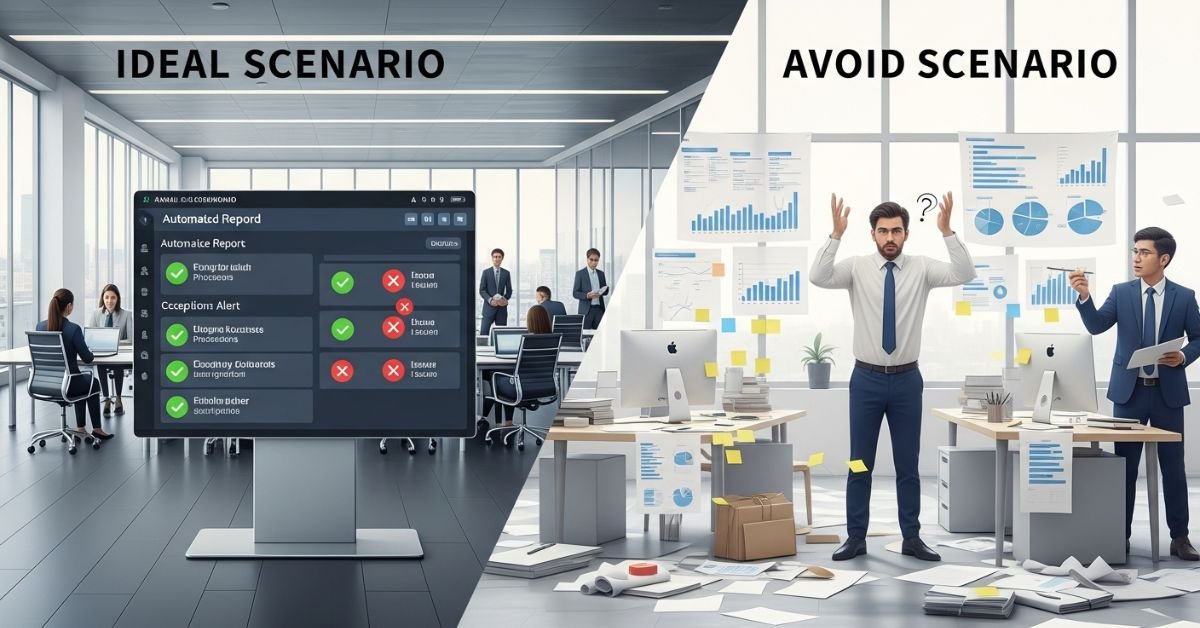
Not every business situation lends itself to this approach. Its effectiveness heavily depends on the maturity of the underlying processes and the precision of performance benchmarks.
It is ideal in these settings:
- Large-scale operations where not every detail can be manually supervised
- Stable business processes with well-documented standards
- Environments where quantitative performance data is readily available
However, caution should be exercised in contexts where:
- New processes or teams are still being calibrated.
- High creativity or customization is required
- Data is insufficient or inconsistently collected
In these situations, manual oversight or hands-on coaching may prove more beneficial than a system that flags only outliers. Managing by exception demands a solid foundation of trust in both systems and people.
Strategic Effects on Decision-Making
Modern organizations often find themselves paralyzed by overanalysis. Management by Exception brings clarity by reducing the volume of data requiring immediate attention while elevating critical issues to the forefront.
When implemented, this method sharpens decision-making in the following ways:
- Decisions are less reactive and more prioritized by significance.
- Focus shifts toward long-term trends, not just momentary fluctuations.
- It encourages leaders to become problem-solvers rather than task managers.
- Routine decisions get streamlined, while complex ones receive proper focus.
In companies that have adopted this operational principle, data quality tends to improve over time, as everyone in the chain understands the importance of accurately capturing metrics that drive action.
Implementation Blueprint for 2026 Businesses
While the concept may seem simple, rolling it out successfully across an organization requires structured planning. Here is a step-by-step approach tailored for current business environments:
- Define rational benchmarks: Begin by identifying key metrics for each team or department. Regular workflows need to be converted into measurable performance indicators.
- Identify exception thresholds: Set upper and lower bounds that define when a result requires escalation.
- Design escalation procedures: Establish workflows for who is notified and how responses should be managed when exceptions occur.
- Integrate tools: Use cloud platforms, dashboards, or even AI assistants to automate alerts based on real-time data inputs.
- Train staff: Employees must understand what they’re accountable for and when to seek managerial support.
- Audit periodically: Maintain performance reviews to adapt thresholds based on evolving conditions.
Technology and human insight have to complement each other for implementation to succeed. Start small, perhaps in finance or procurement, where metrics are already mature.
Technology That Powers the Approach
It’s no longer viable to depend on spreadsheets to track exceptions. Today’s organizations in (Management by Exception) use enterprise-grade systems designed for automation, clarity, and real-time visibility.
For example:
| Tool | Capability | Primary Use Case |
| Microsoft Power BI | Custom alerts, dashboards, and variance analysis | Company-wide performance monitoring |
| Tableau | Data visualization with outlier highlighting | Sales anomalies, regional performance |
| ClickUp Enterprise | Workflow automations based on status triggers | Project and task management |
Augmented by built-in analytics and AI, these tools are now integral to organizational oversight. Companies that leverage these platforms reduce manual data review and limit noise from normal operations.
Real-World Applications Across Industries
This model is industry-agnostic and has been tailored for use across diverse business environments. When applied properly, it has proven results in high-scale settings.
A logistics firm may set delivery benchmarks and flag deviations above 10% of average timing. A delay in one delivery may not raise concern, but repeated lags from a warehouse can signal structural issues.
In corporate finance, monthly variances above 5% in operating costs may be acceptable. Anything beyond triggers an internal review and possibly a change in vendor management processes.
Similarly, customer service departments often flag call response times. Exceeding service-level agreements prompts review, not each query that’s resolved slightly past the target time.
Intelligent exception logic means resources aren’t wasted, and systemic problems are remedied faster.
Common Barriers to Success
Like any strategic transformation, applying this principle can fall flat without proper awareness of challenges.
Some common mistakes include:
- Overly broad thresholds that fail to capture meaningful issues
- Management reluctance to release daily control
- Underdeveloped KPIs without clear visibility
- Failure to train teams on when and how to escalate issues
Resolution lies in clearer definitions, better data hygiene, and embedding accountability into company culture. Feedback loops help refine the system over time, making it more accurate and agile.
The Future of Business Oversight
In 2026 and beyond, the future of business management (Management by Exception) hinges on intelligent alert systems and highly contextual decision frameworks. The next evolution will likely incorporate machine learning to forecast deviations before they surface, allowing leaders to act on exceptions before they fully impact performance.
What used to require human monitoring will soon be augmented, even replaced, by algorithms designed to scan millions of data points for patterns that humans might miss. This further enhances the value of managing by exception not just in reacting to problems, but in preventing them through predictive insight.
As AI integration continues to evolve, businesses that adopt exception-based logic effectively today are positioning themselves ahead of competitors who still rely on blanket oversight.
FAQs
What is management by exception in simple terms?
It’s a system where managers focus only on significant problems or deviations from the norm.
Is this method suitable for every business type?
No, it works best in data-rich, stable environments with defined performance metrics.
How is this different from traditional management?
Traditional management reviews all activities; this method highlights only abnormal results.
Does it replace human oversight?
No, it supports structured oversight by prioritizing where human input matters.
Can small companies benefit from this?
Yes, especially those looking to scale without micromanaging every decision.
Conclusion
In (Management by Exception) the Strategic focus is a vital asset for competitive businesses in 2026. By adopting management by exception, companies shift from over-monitoring to intentional leadership. They eliminate unnecessary noise and turn attention toward anomalies that truly require directional decisions.
It empowers teams through autonomy, reinforces data-informed action, and allows for agility without chaos. Companies that implement this model consistently outperform by responding to real business signals while others are still sifting through reports.Now’s the time to audit your organization’s decision structure. Start defining acceptable performance levels and let technology guide when to raise a flag. The result? A smarter, faster, and more focused business machine ready to thrive.